

ARTS AND CULTURE INFORMATION GATEWAY
Immerse yourself in the colorful world of art and culture! From traditional heritage to contemporary works, discover uniqueness that reflects the nation's identity and identity
 Aras 6 Kiri, Wisma PERKESO, No 26, Jln Susur 5, Off Jalan Tun Abdul Razak, Larkin, 80200 Johor Bahru, Johor Darul Takzim.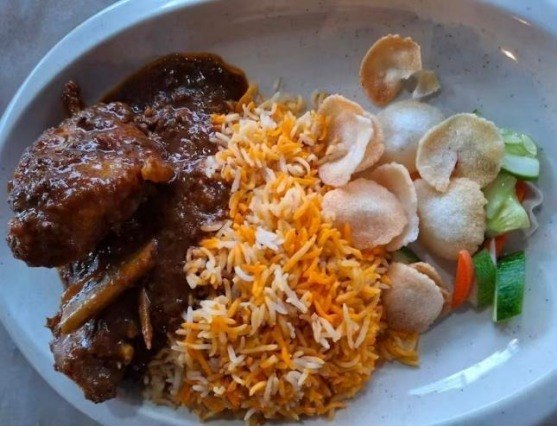
Picture
1
Video
No record
Today's Visitor
50
Number of Visitors
1185
Introduction and history
- Nasi Beriani Gam is a famous traditional food in Malaysia, especially in the districts of Muar and Batu Pahat, Johor. The term beriani comes from the Persian word berya(n), meaning 'fried' or 'roasted', and this dish is said to have been introduced by Persian traders to the Indian and Pakistani communities who migrated to Malaya.
- A specific variation, Nasi Beriani Gam, originates from the Indian-Muslim community, particularly from the state of Tamil Nadu, India. Its main characteristic is that the rice and meat (usually mutton) are cooked separately and then served together in a dense, moist, and 'sticky' form. The name 'Gam' itself comes from the Tamil language, meaning 'tight' or 'sticky', referring to the dense texture of the rice when thickened with the rich meat gravy, unlike other briyani rice, which is fluffier. This cooking technique was created to save ingredients and energy, as well as to ensure every grain of rice is coated in the rich gravy flavor. This dish, also known as Nasi Briyani or Nasi Minyak, has been adapted to local tastes and has become synonymous with restaurants which is selling nasi briyani gam.
- The use of basmati rice and spices such as star anise, cinnamon, cloves, ginger, onions, mint leaves, ghee, and saffron (which provides the golden color) makes Nasi Beriani Gam unique. It is usually cooked with beef, chicken, fish, or shrimp and served during wedding ceremonies for the Malay Muslim community, alongside rendang and sirap bandung.
- In the Malaysian cultural context, briyani rice is not only regarded as a special dish but also carries symbolic meanings of celebration, hospitality, and social status. It is commonly served during important occasions such as Malay-Muslim wedding ceremonies, festive celebrations, thanksgiving feasts, and religious gatherings. In weddings, its presence represents generosity, blessings, and the host’s appreciation towards guests. The dish is often served with side dishes such as rendang, ayam masak merah, vegetable dalca, cucumber pickles, papadom, and sirap bandung (a beverage made from evaporated milk mixed with thick red colouring, rose-flavored syrup, and often served cold with ice cubes)
- Apart from being a main meal, Nasi Beriani Gam also functions as a medium for social interaction. Its preparation requires time, skill, and effort and is often carried out cooperatively, involving family members or the local community. Such shared cooking activities strengthen family bonds, encourage cooperation, and help ensure that traditional recipes and cooking practices are passed down to younger generations.
- From an economic perspective, Nasi Beriani Gam plays an important role in supporting local food businesses. It remains one of the key dishes that attracts customers, whether offered as a daily menu item, catering service, or packaged product for sale. The strong demand for this dish demonstrates its solid commercial value within the country’s food industry.
- Finally, although Malaysia’s culinary landscape continues to evolve with changing times, Nasi Beriani Gam remains an important marker of traditional food identity, especially in the state of Johor. It serves as a bridge between older and younger generations, nurtures a sense of togetherness, and helps preserve culinary heritage within Malaysia’s multicultural society.
-
Large cooking pot
Basmati rice
Beef/ Chicken/ Mutton
Beriani spices (cardamom, star anise, cinnamon, cumin, cloves)
Ginger
Onions
Mint leaves
Basil leaves
Evaporated milk/yogurt
Saffron
Ghee
The meat is cut and marinated with beriani spices, ground onions, ginger, and yogurt or tairu (milk mixed with lime juice).
Marinate this meat for several hours or overnight to ensure the spices are absorbed.
The marinated meat is then cooked with additional spices until tender, and the gravy thickens. In a separate pot, heat ghee.
Sauté spices like cardamom, cinnamon, star anise, as well as sliced shallots, garlic, and ginger until fragrant.
Add the washed basmati rice to the sautéed spices and mix well. Add sufficient water along with saffron (or coloring), salt, and sugar. Cook the rice until it is half-cooked.
In another pot, arrange layers of the half-cooked rice alternating with the meat and its thick gravy. This process is known as 'gam' or 'dam', where the rice and meat are cooked together to allow the aromas and flavors to merge.
Cover the pot tightly (traditionally, the edges of the lid are sealed with wheat flour dough to prevent steam from escaping).
Cook the rice over very low heat until the rice and meat are fully cooked and all aromas are infused.
Nasi Beriani Gam is usually served hot. It can be garnished with fried cashews and raisins, and enjoyed with side dishes like ayam masak merah, pickled cucumber, and papadom.
The method of preparation may vary according to family-specific recipes that have been passed down through generations.
-
Reference Source
Bahan Bacaan
Blogger. (n.d.). Nasi Beriani Gam Johor. Malay Cook Spices. Retrieved November 14, 2025, from http://malay-cook-spices.blogspot.com/2011/04/nasi-beriani-gam-johor.html
Johor Kaki. (2012, March 23). Nasi Baryani @ Mohd Shah in Batu Pahat, Johor, Malaysia. https://johorkaki.blogspot.com/2012/03/nasi-baryani-mohd-shah-in-batu-pahat.html
MalaysianChefs. (2024, March 10). Nasi Briyani-Famous Malaysian cuisine. https://malaysianchefs.com/nasi-briyani-famous-malaysian-cuisine/
The Vocket. (2015, March 24). 2 lokasi Nasi baryani wajib pergi di Batu Pahat. https://thevocket.com/2-lokasi-nasi-baryani-wajib-pergi-di-batu-pahat/
Informan
Nasi Baryani Mohd Shah. Gerai No. 14, Kompleks Niaga Peserai (Benteng Peserai), Jalan Peserai, 83000, Batu Pahat, Johor. (+60 11-18788322)
Restoran BP Baryani Power. 18, Jalan Tukas 2, Taman Soga, 83000 Batu Pahat, Johor. (+60 12-712 0987)
Location
State JKKN Contact Information
Puan Norazlina binti Othman
Cultural Officer
Jabatan Kebudayaan dan Kesenian Negara, Johor
Aras 6 Kiri, Wisma PERKESO
No 26, Jalan Susur 5
Off Jalan Tun Abdul Razak, Larkin
80200 Johor Bahru
JOHOR DARUL TAKZIM
07-224 8270 / 223 1249
Use the form below to contact the Informant/Figure/Editor/Researcher directly. We will respond to your inquiry as soon as possible!


