

ARTS AND CULTURE INFORMATION GATEWAY
Immerse yourself in the colorful world of art and culture! From traditional heritage to contemporary works, discover uniqueness that reflects the nation's identity and identity
BAJU PUTERI KEBAYA LABUH PERAK
 Fakulti Muzik dan Seni Persembahan, Universiti Pendidikan Sultan Idris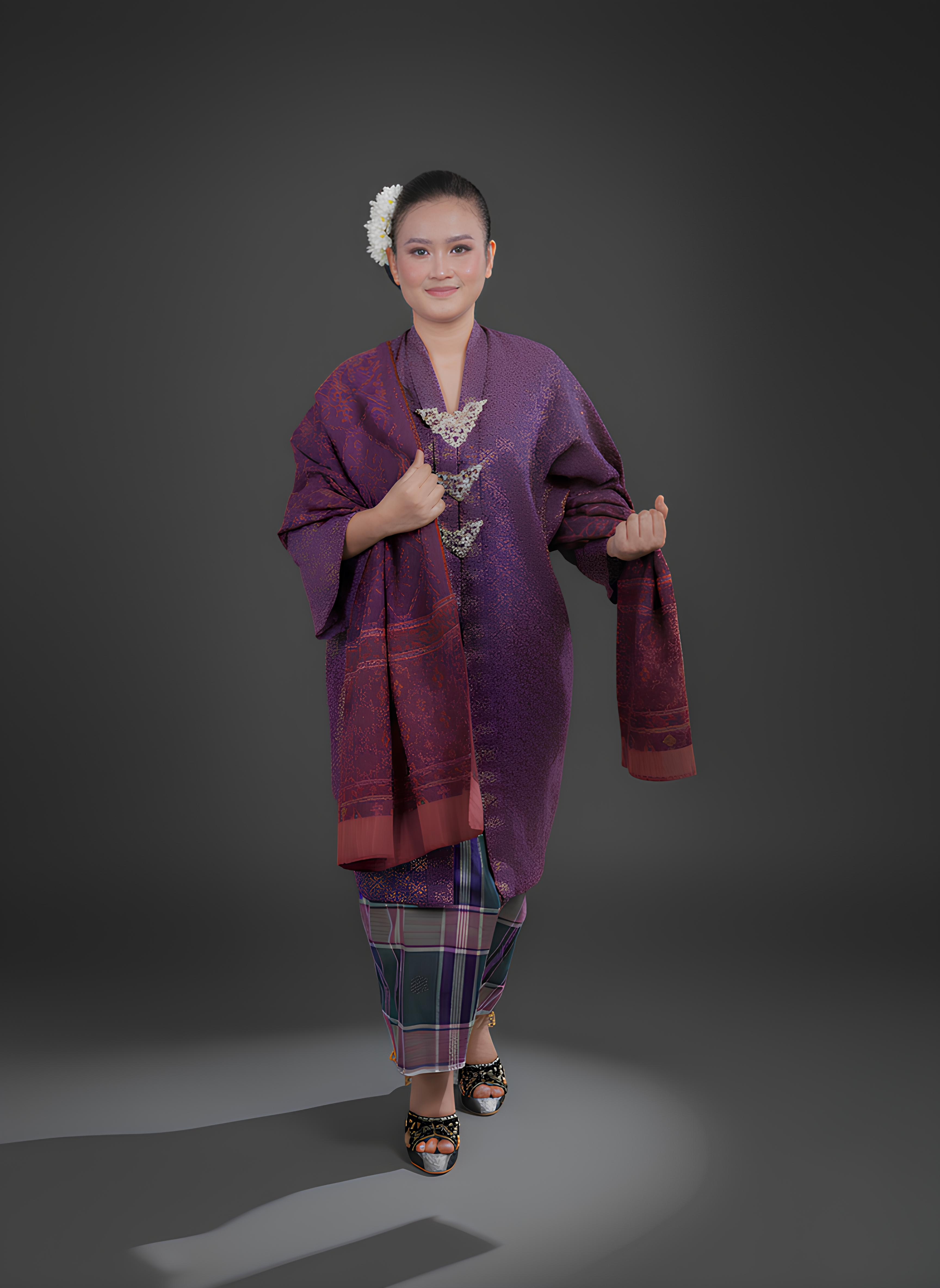
Picture
1
Video
No record
Today's Visitor
25
Number of Visitors
4623
Introduction and history
- The Puteri Kebaya Labuh of Perak is one of the traditional Malay women’s attires that embodies the elegance and refined artistry of Perak’s cultural heritage. Its uniqueness lies not only in its long and modest design but also in its historical evolution across the Malay Peninsula, where it eventually became the defining attire of the noblewomen of Perak’s royal lineage.
- The origin of the term kebaya itself reflects a fascinating process of cultural assimilation. The word kebaya is derived from the Portuguese term “Cabaya,” which means a tunic or an outer robe. The term was introduced to the Malay world during the Portuguese occupation of Melaka (1511–1641). The Portuguese, in turn, borrowed it from the Arabic word “Qaba’,” which originated from the Persian meaning robe of honour. The earliest record of this term dates back to 1553, when João de Barros described it as an attire commonly worn by Muslims. Variants of the term include Kabaya, Cabie, Cabaia, Cabaye, Caba, and Kabaai. Over time, Kebaya became a widely used term across the region to refer to a tunic or outer garment.
- From Melaka, the cabaya or kebaya style of clothing spread throughout the Malay Archipelago, including Java, Sumatra, and the Malay Peninsula. During its dissemination, the form and design of the attire underwent local adaptation to suit the aesthetic preferences, customs, and religious influences of each region. In the Malay world, the kebaya was modified to be more modest and refined, using soft fabrics such as silk, songket, or fine cotton, with a longer cut that covered the hips and thighs.
- The development of the kebaya in Perak is closely associated with royal cultural exchanges and intermarriages that connected Perak with other Malay states such as Johor, Melaka, and Selangor in the 19th century. Through these royal ties, the kebaya evolved and took on a distinct Perak identity influenced by courtly aesthetics. Within the palace, it became known as the Puteri Kebaya Labuh, serving as official attire for royal princesses and noblewomen of Perak during traditional ceremonies, weddings, and state celebrations.
- The distinctive features of the Puteri Kebaya Labuh of Perak include a loose-fitting cut that extends to knee length, with three-quarter sleeves, about a hand’s width from the wrist, allowing for the wearing of bangles or arm accessories. The attire is worn with a folded sarong in the bertimpuh (overlapping) style, resembling the traditional Perak batik sarong. It is then adorned with a set of three cascading gold or silver brooches at the chest, ankle bangles, gold-threaded velvet slippers, and hair ornaments such as the sanggul lintang or cucuk sanggul. To complete the look, a long shawl is gracefully draped over the right shoulder to modestly cover the chest area.
- Over time, the Puteri Kebaya Labuh of Perak has undergone several transformations to suit modern styles and occasions. However, these changes continue to preserve the original elements that reflect Perak’s cultural identity and royal heritage. The kebaya still retains its long and loose silhouette, while modern designs incorporate varied fabrics, pastel tones, and delicate beadwork, giving it a contemporary touch without diminishing its traditional authenticity.
In the past, the Puteri Kebaya Labuh of Perak was an exclusive garment worn only by royal princesses and noblewomen of the Perak palace. It was traditionally donned during official royal ceremonies, customary rituals, engagements, weddings, and state celebrations. Its purpose extended beyond mere adornment—it symbolised rank, prestige, and the elevated status of women from the aristocracy.
Today, with the passage of time, the Puteri Kebaya Labuh of Perak is no longer confined to the royal court. It has been revived as a cherished heritage costume of the state of Perak and is now widely worn by the public during festive occasions, cultural performances, heritage festivals, and traditional costume competitions. Although contemporary versions feature modern designs and a wider variety of fabrics, the kebaya continues to uphold its core traditional elements and values of modesty, remaining a timeless symbol of Perak’s refined cultural identity.
To complete the appearance of the Puteri Kebaya Labuh of Perak, the attire is complemented with a range of traditional accessories that enhance its grace, sophistication, and royal charm:
Three Cascading Brooches
Made of gold or silver, these brooches are fastened along the chest to secure the kebaya neatly while adding elegance and refinement to the overall look.
Sanggul Lintang or Sanggul Tinggi (Traditional Hair Bun)
A traditional Perak-style hairstyle, neatly arranged at the back of the head and adorned with hairpins or fragrant tanjung flowers, reflects classic feminine beauty and poise.
Earrings
Various styles of earrings can be worn, such as clasp earrings, stud earrings, or dangling earrings, typically crafted from gold or silver to accentuate the wearer’s elegance.
Bangles and Anklets
The Gelang Pahat Jawa (carved bangles) and Banggel-style anklets are traditionally made of gold, silver, or sometimes copper. These are usually worn in pairs on both sides, symbolising balance and grace in traditional adornment.
Long Shawl
Draped over the right shoulder and allowed to flow gently over the arm or left side, the selendang serves as a symbol of modesty and decorum, subtly covering the upper chest area.
Gold-Threaded Velvet Slippers
Traditional footwear made of velvet fabric embroidered with fine gold thread, perfectly complements.
The materials used in crafting the Puteri Kebaya Labuh of Perak play a vital role in showcasing the beauty, luxury, and refinement of this traditional attire. Each fabric is carefully selected to reflect the grace and cultural prestige associated with the women of Perak’s royal heritage. The main materials used include:
Blouse Fabric (Upper Garment)
The upper part of the attire is made from handwoven songket fabric, which serves as the primary material for this traditional ensemble. The intricate gold or silver threadwork woven into the songket enhances its traditional identity while highlighting the wearer’s elegance. Common motifs include bunga tanjung (tanjung flower), pucuk rebung (bamboo shoot), and awan larat, patterns, all of which symbolise beauty, growth, and continuity in Malay culture.
Songket Sarong Fabric (Lower Garment)
For the lower section, a songket sarong with pelikat-inspired patterns is used. The pelikat design features a balanced combination of colours and checkered lines, giving the attire a timeless yet understated charm. The sarong is wrapped neatly around the waist in the traditional bertimpuh fold, similar to the customary way Malay women wear their sarongs, ensuring modesty and elegance in movement.
Shawl (Outer Accessory Layer)
The shawl, also typically made from songket with scattered floral motifs (bunga tabur), serves as the main finishing accessory of this ensemble. Measuring approximately 1.5 to 2 metres in length, depending on the wearer’s height, it is gracefully draped over the shoulder. Occasionally, small beads or crystals are added to the shawl to enhance its opulent appearance, further elevating the grandeur and sophistication of the entire costume.
The wearing of the Puteri Kebaya Labuh of Perak follows similar principles to other traditional Malay attire, but requires care and precision to preserve its elegance and highlight the wearer’s poise. Each step of the dressing process contributes to the overall charm and sophistication of this royal ensemble. The steps are as follows:
Wearing the Sarong (Lower Section)
The songket sarong with pelikat patterns is neatly wrapped around the waist using the bertimpuh (overlapping) folding technique.
The front pleat must be straight and tidy to create a graceful and modest silhouette.
The length of the sarong should be adjusted to ensure it is neither too short nor too long, allowing for easy movement while maintaining decorum.
Putting on the Kebaya Labuh (Upper Section)
The kebaya top is draped gracefully over the shoulders and adjusted until it reaches knee length.
The chest area is fastened and decorated with a set of three cascading brooches, which serve as both a clasp and a central adornment.
The three-quarter sleeves should fit neatly, exposing the wrists that are typically adorned with bangle-style bracelets.
Draping the Songket Shawl (Finishing Touch)
The songket shawl with scattered floral motifs (bunga tabur) is elegantly draped over the right shoulder, allowing it to flow softly towards the left arm or side.
The shawl serves not only as a decorative element but also as a symbol of modesty and gentleness, embodying the grace of Perak’s noblewomen.
Completing the Look with Accessories
The sanggul lintang or sanggul tinggi hairstyle is styled neatly, adorned with hairpins or fragrant tanjung flowers.
Earrings, bangles, and anklets are worn to complete the traditional royal aesthetic.
Finally, a pair of velvet slippers embroidered with gold thread is worn, accentuating the luxury and exquisite craftsmanship of Perak’s textile heritage.
-
Reference Source
Bahan Bacaan
Dalgado, S. R. (1988). Portuguese vocables in Asiatic languages: From the Portuguese original of Monsignor Sebastião Rodolfo Dalgado (p. 60). India: Asian Educational Services.
Lee, P. (2014). Sarong Kebaya: Peranakan fashion in an interconnected world, 1500–1950 (pp. 25–26). Singapore: Asian Civilisations Museum. ISBN 9789810901462.
Jabatan Kebudayaan dan Kesenian Negara (JKKN) Perak. (2016, Februari). Info seni budaya: Tahukah anda Puteri Kebaya Labuh Perak? Retrieved from https://jkknperak.blogspot.com/2016/02/nfo-seni-budaya-tahukah-anda-puteri.html
Location
State JKKN Contact Information
Encik Yufazli Yusof
Cultural Officer
Jabatan Kebudayaan dan Kesenian Negara Perak
Kompleks JKKN Perak,
Lot 20561@20565 Jalan Caldwell,
Off Jalan Raja Di Hilir,
30350 Ipoh,
PERAK DARUL RIDZUAN
05-253 7001 / 05-254 1027
Use the form below to contact the Informant/Figure/Editor/Researcher directly. We will respond to your inquiry as soon as possible!

