

ARTS AND CULTURE INFORMATION GATEWAY
Immerse yourself in the colorful world of art and culture! From traditional heritage to contemporary works, discover uniqueness that reflects the nation's identity and identity
 Fakulti Muzik dan Seni Persembahan, Universiti Pendidikan Sultan Idris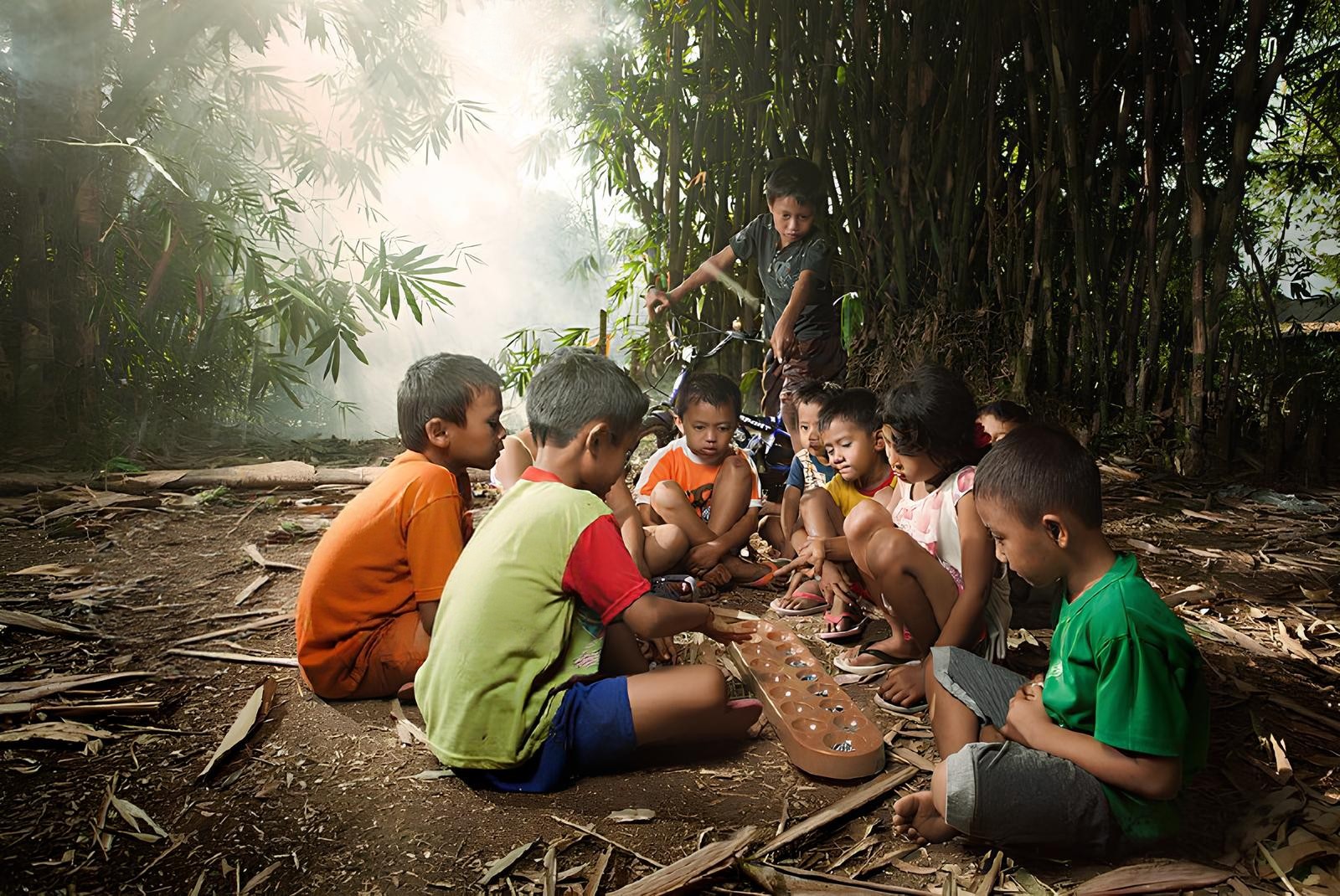
Picture
5
Video
No record
Today's Visitor
2749
Number of Visitors
7331
Introduction and history
Congkak is one of the traditional games strongly associated with the Malay community in Malaysia, and it continues to be played to this day. In addition, congkak is also popular in other parts of the Malay Archipelago, such as Indonesia, Singapore, Brunei, and the Philippines, making it a shared cultural heritage of the region. This game belongs to the family of “Mancala” games, a type of board game based on strategy and counting using small seeds or marbles.
The origins of congkak are believed to trace back to Africa or the Arab world before spreading across the globe. The earliest archaeological evidence suggests that a form of this game has existed since around 5000 to 7000 BC, when archaeologists discovered limestone pieces with two parallel rows of holes in the area now known as Jordan. From the Middle East, the game spread to Africa and was later brought to Southeast Asia by Arab traders who were active in the region. Within the Malay world, particularly in Malacca, congkak flourished due to the state’s role as a major international trading hub in the 15th century.
The name congkak derives from the Malay word congak, which means “mental calculation.” This reflects the essence of the game, which requires intelligence, quick thinking, and strategic counting skills. In Malaysia, congkak was not only popular among the Malays but also embraced by the Indian Peranakan and Baba Nyonya communities in Malacca. In the past, congkak carried different social dimensions: the nobility played on elaborately carved boards made of fine wood as a symbol of status. At the same time, common villagers dug holes in the ground and used small stones or seeds as playing pieces.
The influence of congkak even transcended geographical boundaries. In the Caribbean, the game is known as Warri or Awari, believed to have been introduced through the slave trade. In Indonesia, it is known as Congklak, while in the Philippines, it is referred to as Sungka. Although there are variations in the design of the boards and the rules, the fundamental principle remains the same: strategically distributing seeds into the holes of the board.
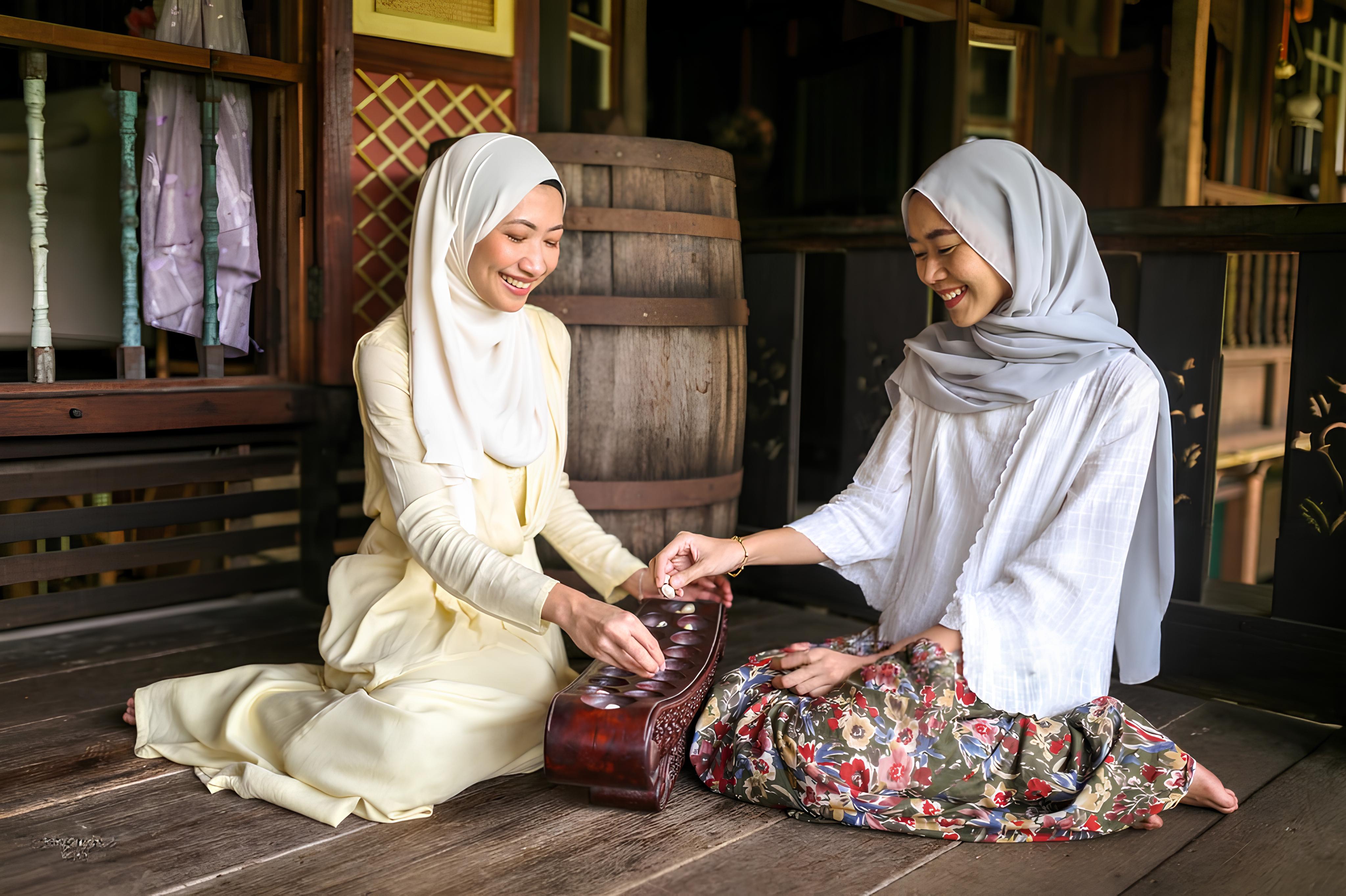
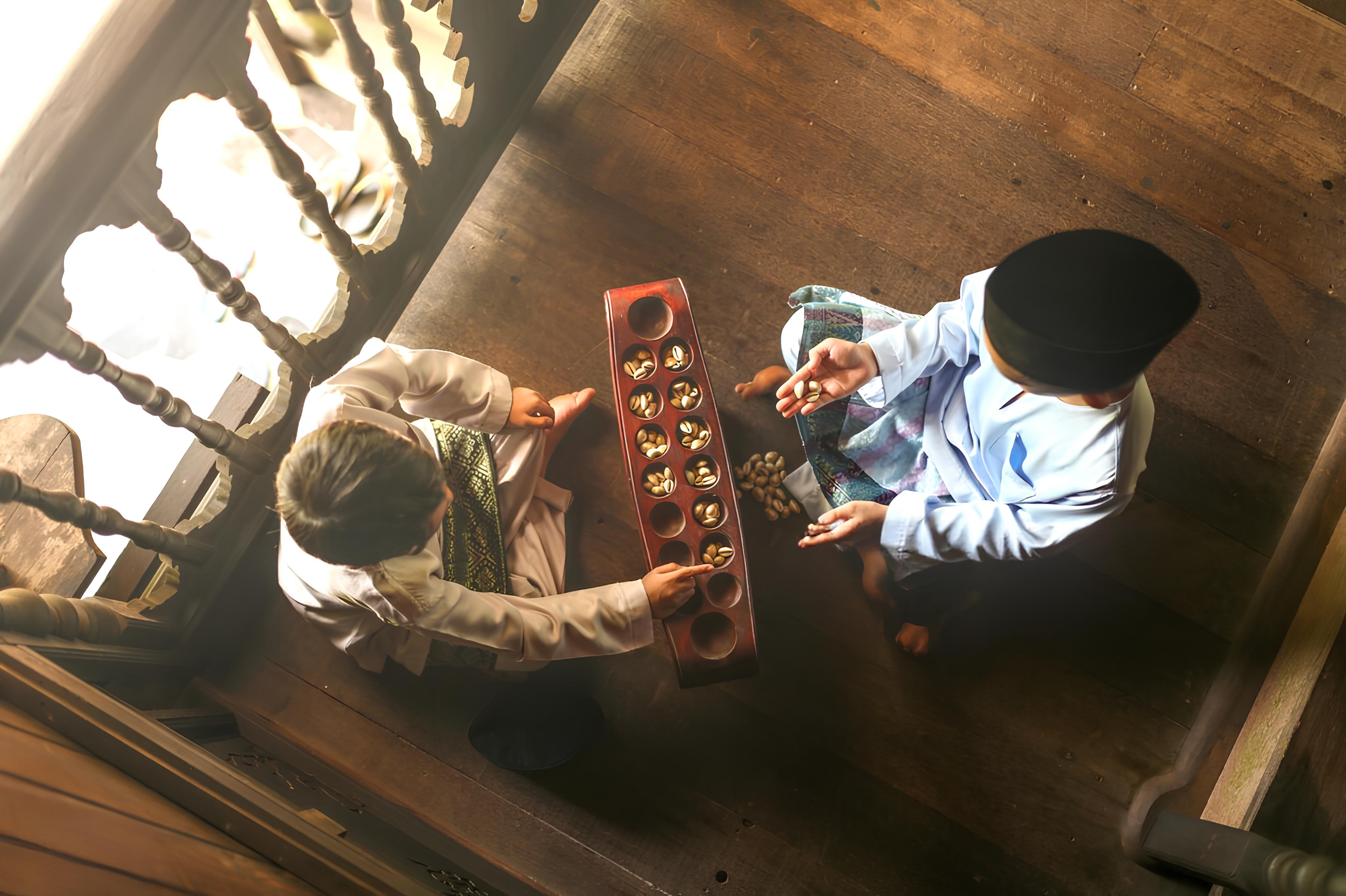
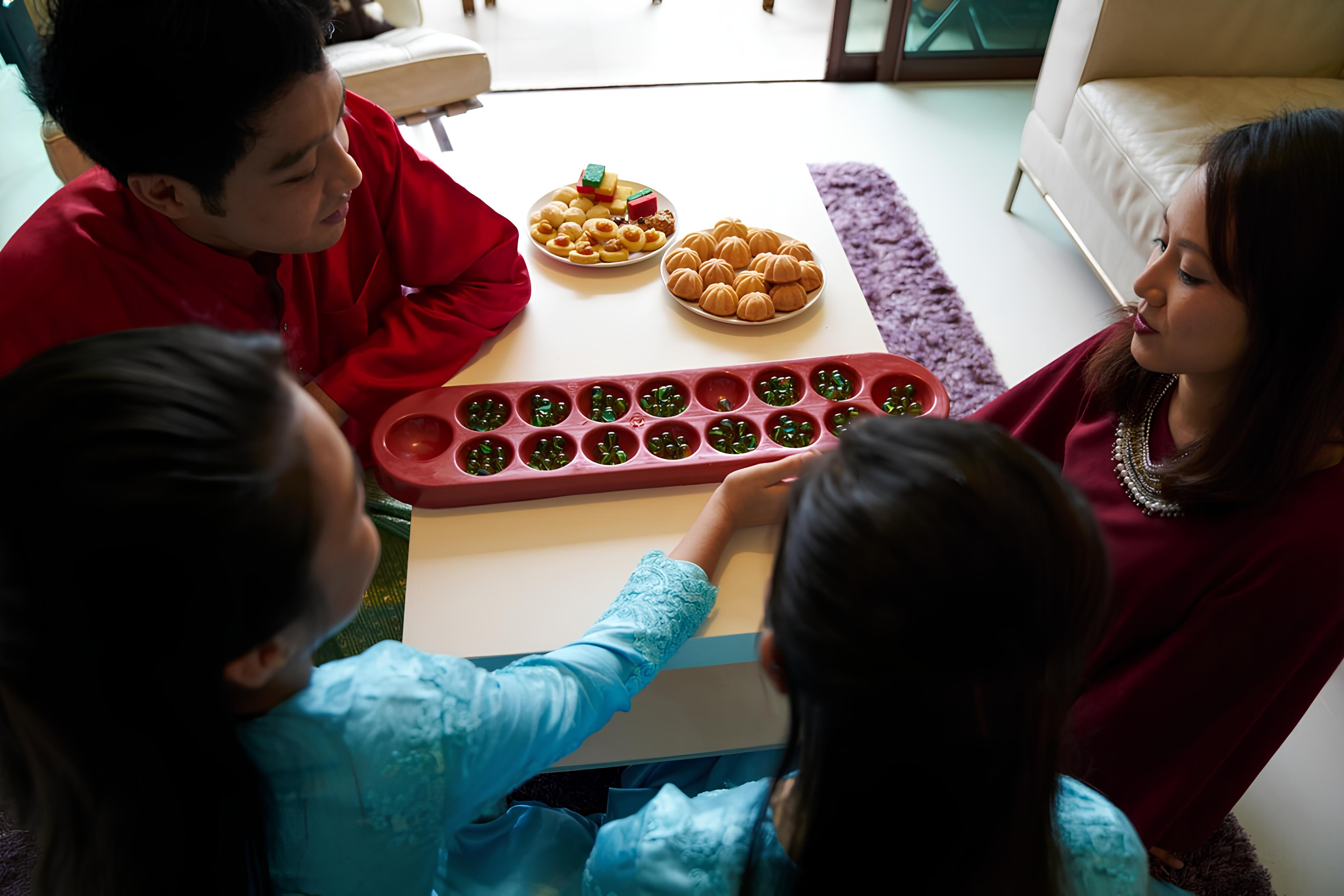
In terms of equipment, congkak in Malaysia involves two main components: the congkak board and the congkak seeds. The board is usually elongated in the shape of a boat and made of hardwood such as cengal or merbau. It features several small holes known as kampung (villages) and two larger holes at both ends called rumah (houses) or ibu (mother). There are variations of the congkak board with five, seven, or nine village holes, but the seven-hole version is the most commonly used in Malaysia. A typical board measures about 80 centimetres in length and 18 centimetres in width, making it convenient to play on the floor or on a table. The congkak seeds can be glass marbles, red saga seeds, rubber seeds, or any small, rounded objects. Traditionally, each kampung hole is filled with an equal number of seeds (usually seven per hole) before the game begins.
In conclusion, congkak is not only rooted in a long global history but has also evolved into an important cultural heritage in Malaysia, symbolising the identity, creativity, and intellectual traditions of the Malay community. Today, congkak continues to be played as both popular entertainment and an educational heritage, serving as a cultural identity marker passed down through generations.
Congkak is not only a traditional game that serves as a source of entertainment for the people, but it also carries deep educational, social, and cultural values within traditional Malay society. From an educational perspective, the game trains children to think logically, perform mental calculations, and refine their basic mathematical skills, including addition, subtraction, and division. Players who are skilled in mental arithmetic (congak) are better able to devise strategies, control the movement of seeds, and ultimately score more points, making congkak an effective tool for intellectual training.
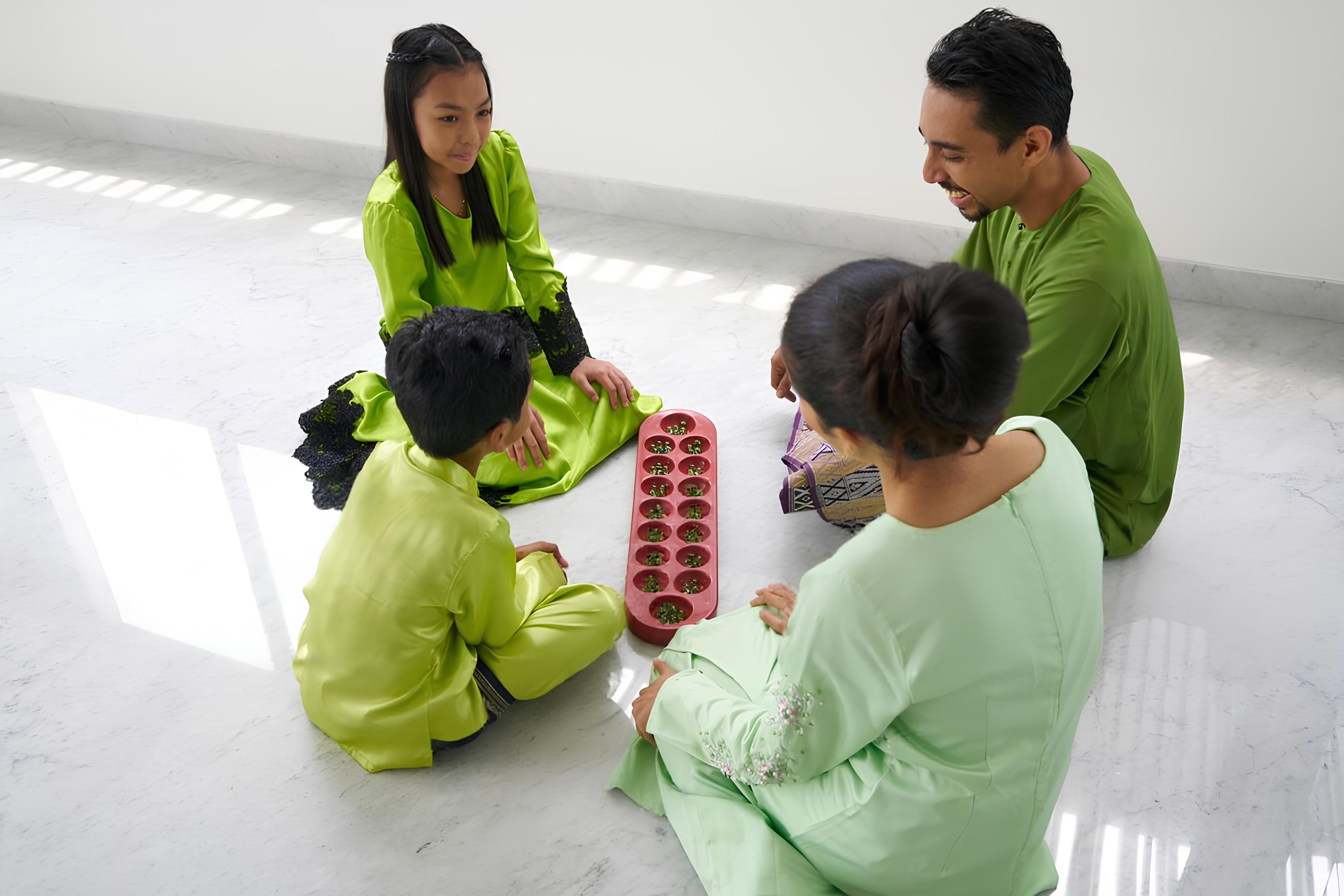
From a social perspective, congkak functions as a medium of interaction and a bridge of kinship within families and communities. It was often played casually in courtyards, village halls, or during festive gatherings, creating a friendly atmosphere and strengthening relationships across generations. The game also emphasises values such as patience and attentiveness, since players must carefully plan their moves while respecting their opponent’s turn.
In addition, congkak carries cultural and symbolic roles. In the Malay royal courts of the past, congkak was not merely a pastime but also a symbol of status, as boards were often made of luxurious wood with intricate carvings. In contrast, common villagers played using simple holes dug into the ground, with stones or seeds as playing pieces. This contrast reflects how congkak was embedded in social hierarchy and cultural aesthetics. Today, congkak continues to play an important role as a cultural heritage passed down through generations. It is frequently showcased at cultural festivals, heritage exhibitions, and traditional games competitions, serving as both a marker of Malay identity and a treasured national heritage.
From a global perspective, congkak also functions as a cultural diplomacy tool, introducing the uniqueness of Malay heritage to the world. Its presence in educational programs, interactive museums, and cultural tourism activities demonstrates that congkak is not only relevant in the past but continues to thrive in modern contexts. Thus, the functions and roles of congkak extend beyond mere entertainment; it is an educational medium, a cultural symbol, and a social bridge that embodies the resilience and beauty of Malay heritage.
-
The two main components in congkak are the congkak board and the congkak seeds.
The congkak board:
Usually made of hardwood such as cengal or merbau, and elongated in shape.
It consists of two parallel rows of small holes (each row containing either 7 or 9 holes, depending on the variation) and two larger holes located at both ends of the board, known as the rumah (house) or ibu (mother).
The congkak seeds:
Typically consist of glass marbles, saga seeds, or rubber seeds.
Each small hole is traditionally filled with seven seeds (or any agreed number, depending on the rules set by the players).
Congkak is played by two players who sit facing each other with the congkak board placed in between. The board consists of rows of small holes called kampung (villages) and two larger holes at each end known as rumah (houses) or ibu (mother). Each player’s rumah is located at the far-left end of the board according to their position.
Game Preparation
Before the game begins, each kampung hole is filled with an equal number of congkak seeds, usually seven (though sometimes five or nine depending on the variation). The rumah holes are left empty. The seeds can be made of glass marbles, saga seeds, rubber seeds, or small stones.
Starting the Game
The game begins with both players simultaneously selecting one kampung from their side of the board and picking up all the seeds within it. The seeds are then distributed one by one into the subsequent holes in a clockwise direction, including the player’s own rumah but excluding the opponent’s rumah. The distribution continues until the last seed is dropped.
Special Movement Rules
Dead (stop): If the last seed falls into an empty hole on the player’s own side, the turn ends immediately and is considered “dead.”
Capture (tembak): Suppose a player completes a full round, passing their own rumah and returning to their side, and the last seed falls into an empty hole. In that case, the player may “capture” (tembak) by collecting all seeds from the directly opposite hole in the opponent’s row.
Extra turn: If the last seed lands in the player’s own rumah, the player earns an additional turn and may continue by selecting seeds from any occupied kampung on their side.
Dead on opponent’s side: If the last seed falls into an empty hole on the opponent’s side, the turn ends immediately without capture.
General Rules of Play
Players take turns alternately until all seeds have been distributed.
If it is a player’s turn but none of their kampung contains seeds, the turn automatically passes to the opponent.
After the first round ends, each player refills their kampung with seeds taken from their rumah. Any kampung that cannot be refilled due to insufficient seeds is considered “burned” (terbakar) and may no longer be used in subsequent rounds.
Determining the Winner
The game continues until one player no longer has enough seeds to place even one in a kampung. At the end of the game, the seeds inside each rumah are counted. The player with the greater number of seeds in their rumah is declared the winner. If both players have the same number of seeds, the one with more “burned” kampung is considered the loser.
Differences from Similar Games
Although congkak shares similarities with other seed-and-hole board games such as Mancala in Africa or Sungka in the Philippines, there are distinctive differences. The most notable is that in congkak, both players begin playing simultaneously during the first turn. In addition, the distribution of seeds in congkak moves in a clockwise direction, whereas many related games are played in a counterclockwise direction.
-
Reference Source
Bahan Bacaan
National Library Board Singapore. (n.d.). Congkak – Singapore. National Library Board. Retrieved from https://www.nlb.gov.sg/main/article-detail?cmsuuid=7bedd52d-ff96-472d-b423-4dc6790e98c8
Wikipedia contributors. (2025, August). Southeast Asian mancala. In Wikipedia. Retrieved from https://en.wikipedia.org/wiki/Southeast_Asian_mancala
Ismail, I., & Yahaya, N. (2020). Enjoyment of learning basic math through Congkak game-based learning. ResearchGate. Retrieved from https://www.researchgate.net/publication/339164942_Enjoyment_of_Learning_Basic_Math_Through_Congkak_Game-Based_Learning
Erlina, Mastura, E., Herrera, L. A., & Norli, M. A. (2023). The effectiveness of the traditional Congklak game in developing fine motor skills in early childhood at the Kasih Bunda Kindergarten, South Aceh. Journal of Basic Education Research, 4(3), 146–155. https://doi.org/10.37251/jber.v4i3.866
Oh, H. K., & Mat Nayan, S. (2019). Jom main! (Let's play!): Promoting the values of Malaysia traditional children’s games through the media. Media Literacy and Academic Research Studies, 2(2), 52–55. Retrieved from https://www.mlar.sk/wp-content/uploads/2019/12/3_Oh_Hui_Kun.pdf
Regina. (n.d.). Congkak: Variations through design transformation. Scribd. Retrieved from https://www.scribd.com/document/416321732/107-1-253-1-10-20181203-pdf
Location
State JKKN Contact Information
Cultural Officer
Jabatan Kebudayaan dan Kesenian Negara
Use the form below to contact the Informant/Figure/Editor/Researcher directly. We will respond to your inquiry as soon as possible!


