

ARTS AND CULTURE INFORMATION GATEWAY
Immerse yourself in the colorful world of art and culture! From traditional heritage to contemporary works, discover uniqueness that reflects the nation's identity and identity
TARIAN ‘BERASIK’ DALAM PERUBATAN TRADISI ETNIK BISAYA
 Laman Seni, Tuan Jamil bin Mijin, Kg Tarat Padas Damit, 89800 Beaufort, Sabah

Picture
6
Video
Available
Today's Visitor
4
Number of Visitors
7016
Introduction and history
The Berasik dance is part of the traditional healing practices of the Bisaya
community in Beaufort, Sabah. It is a ritual performed to expel disturbances caused
by spirits believed to be the source of illness or affliction in individuals. The
ceremony is led by a shaman known as the babalian, who plays a central role in the
healing process. This dance is not merely a physical performance but also involves
the chanting of incantations, the use of specific musical instruments, and ritual
objects to summon spirits and restore the patient's spiritual balance.
The Bisaya community believes that certain illnesses are caused by disturbances
from the spirits of the deceased or supernatural beings known as mitogom. Thus,
the Berasik dance is not simply a cultural performance but carries deep spiritual
significance, whereby the babalian interacts with the supernatural realm to heal the
afflicted. Typically, the ritual practitioner moves in circular motions around a
structure called the Sokuban, a tall shrine suspended from the roof to the floor of
the house. The Sokuban is decorated with leaves collected from burial grounds,
various types of flowers such as paper flowers, cempaka, and melur, as well as
mayang pinang (areca palm blossom). These decorative elements are believed to
serve as places where the spirits can dwell or cling to during the ritual. As the
ceremony begins, the dancers perform the Berasik dance in circular motion around the Sokuban, as a form of veneration and invocation of the spirits involved.
Traditionally, the Berasik dance plays a significant role in addressing spiritual
disturbances caused by malevolent entities. It is believed to have the power to
expel evil spirits that afflict the patient, thereby helping to restore the individual's
spirit and spiritual balance. Additionally, the dance functions as a means of
establishing a pact with supernatural entities, as maintaining harmonious relations
with the spirit world is considered essential within Bisaya beliefs to prevent future
misfortunes. Beyond its role as a healing ritual, the Berasik dance also reflects the
Bisaya community’s rich performing arts heritage, passed down through
generations. It stands as a symbol of cultural identity and traditional beliefs that
continue to be respected and appreciated by the present generation.
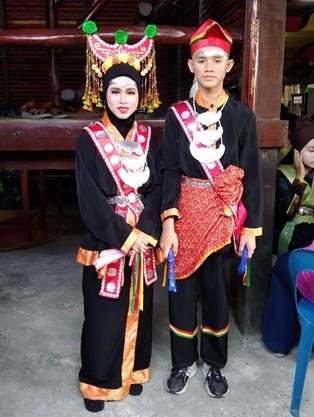
The costumes worn by Berasik dance performers typically feature the traditional
attire of the Bisaya ethnic community. The basic outfit consists of a black blouse
adorned with golden lace embroidery and dangling beads. This blouse is paired
with a long sarong skirt for female dancers and long trousers for male dancers.
Male performers also wear the Salindang Songkit, a sash made from songket
fabric. The costume is further complemented by the Sawit, a red sash decorated with circular aluminum discs resembling silver coins, which is worn diagonally
across the shoulders of each dancer. The distinctiveness of the Berasik dance
costume lies in its elaborate and complex accessories, with female dancers wearing
approximately twelve types of ornaments, while male dancers wear around seven
types.
For head accessories, female dancers wear the Pisanggul, a crown-like headpiece
adorned with dangling beads or small flowers attached to each corner, extending to
the upper back. Alongside the Pisanggul is the Kubamban, a floral head ornament
arranged in a circular formation atop the head. Male dancers, in contrast, wear the
Tajuk, a traditional headdress crafted from songket fabric. In addition, both male
and female dancers are required to wear a forehead ornament known as the
Sarabang, made of silver and designed to follow the shape of both eyebrows,
featuring engraved star motifs.
Around the neck, dancers wear a chain necklace called the Kotol. The hand
accessories, known as Golong Longon, are bracelets made from silver or engraved
aluminum plates featuring floral patterns. Finally, the waist accessories include the
Aut, a golden metal belt for male dancers and a circular silver belt for female
dancers. Furthermore, all performers carry multi-colored handkerchief props in
shades of green, red, and yellow during the performance.
Musical Instruments
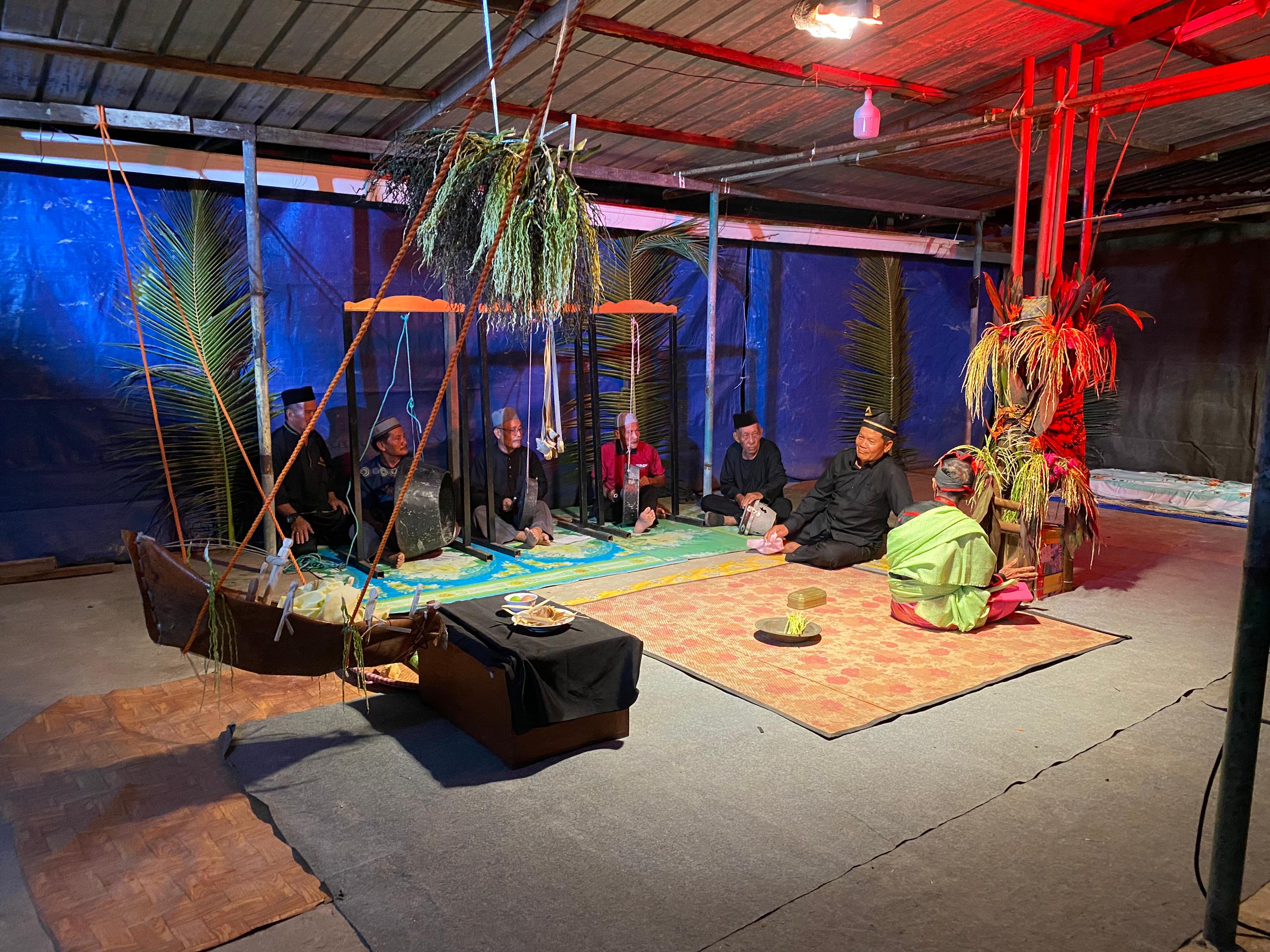
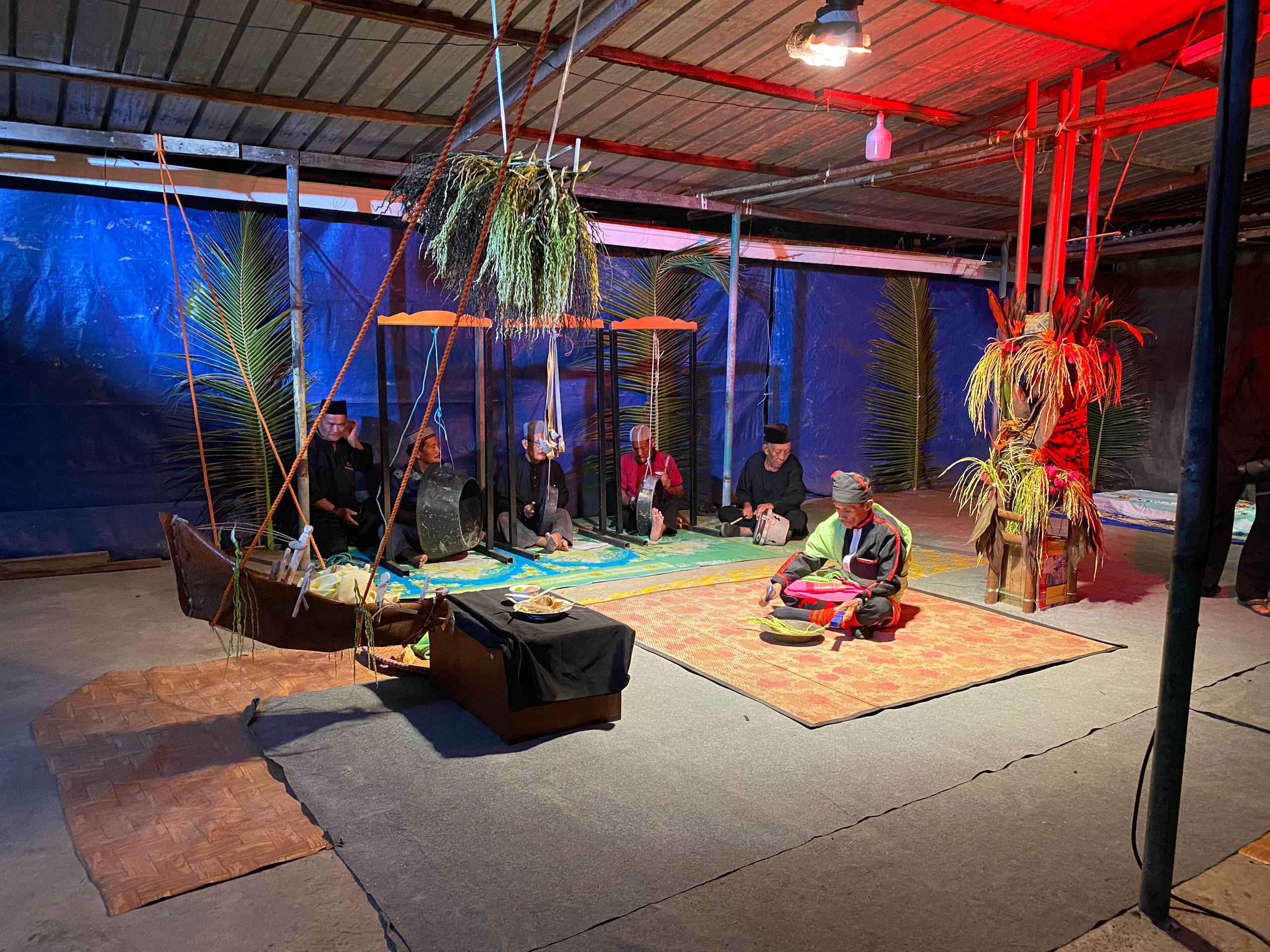
The rhythm or music accompanying the performance of this dance is known as the Berasik rhythm, which is played using a traditional instrumental ensemble consisting of gongs, kulintangan, and drums. The gong set includes five types: Maginsarok gong, Mangilambat gong, Managongo gong, Canang 1, and Canang 2. Meanwhile, the kulintangan instrument consists of eight to ten small knobbed gongs, accompanied by the beats of a kompang (frame drum), which is struck using two wooden mallets called Tabuh or Baloh. Typically, these musical instruments are played by a group of male musicians known as the Bagandang, most often composed of young men within the community.
Ritual Equipment
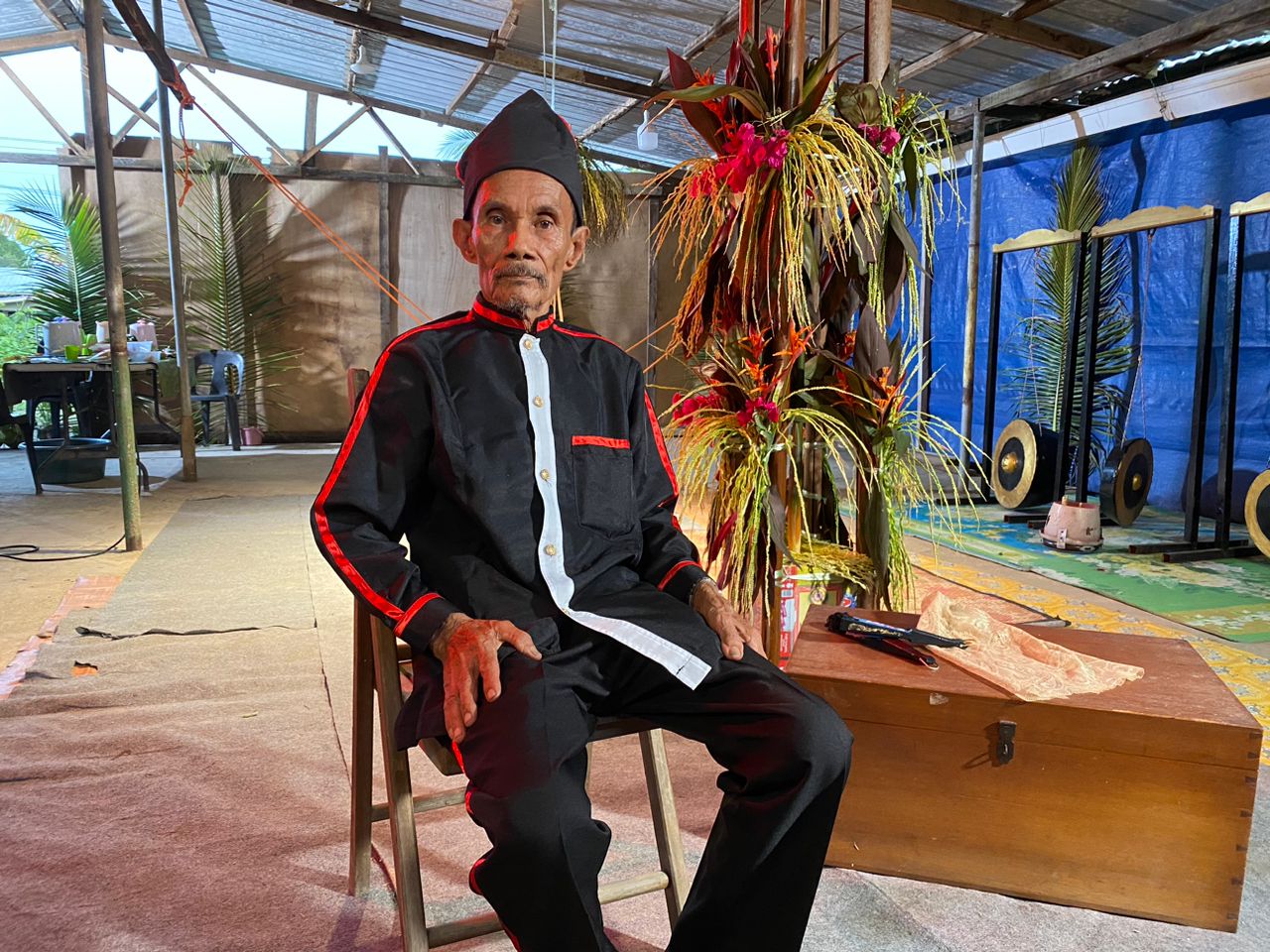
Sangkuban
A structure decorated with flowers and coconut leaves serves as an offering platform for the spirits.
Ritual Offerings
Yellow rice, a bowl of water, eggs, red ginger, ketupat (rice dumplings), betel leaves, and areca nuts.
Biduk
A miniature boat symbolizes the spiritual journey of the supernatural beings.
The Berasik dance is performed in pairs, consisting of both male and female dancers, with the number of pairs typically ranging from four (4) to eight (8). The basic movements of the dance emphasize gentle waving hand gestures that mimic the motion of the Simpapataan bird (commonly known as the magpie robin), performed in a circular floor formation. Within this formation, seven (7) variations of Berasik dance movements are incorporated.
The first variation, Tangan Melambai (Waving Hands), involves softly waving the hands while holding a handkerchief raised to waist level. The second variation, Silat Gayung, features swift silat-inspired movements as the body shifts to the right and left. Next, Insud-Insud refers to a movement where the feet are dragged alternately to the left and right, with the soles forming a "V" shape, the heels touching while the toes are spaced approximately one hand span apart. The fourth variation, Itik Berenang Maju (Swimming Duck Forward), presents a sidestepping movement to the right, while both hands are placed at the left side of the waist.
The fifth variation, Itik Berenang Mundur (Swimming Duck Backward), involves sidestepping to the left with the hands positioned at the right side of the waist. The sixth variation, Liput-Liput, refers to stationary spinning movements with small steps taken forward and backward. Finally, the seventh variation, Gakud Manukad, displays a bending posture while crossing the legs with a stance one to two feet wide; if the right foot is positioned forward, the left foot crosses behind, and vice versa. All of these basic variations serve as the foundation of the dance movements; however, in contemporary practice, numerous additional variations and creative adaptations have been introduced to make the performance more visually engaging and relevant to modern audiences.
Informants
Mr. Charmmy Ladong. Girumpung Baatan Asal Kampung Ta-ee(GBAT). Kampung Taee, Serian, Sarawak.
Mr. Andrisse Ridu. Girumpung Baatan Asal Kampung Ta-ee(GBAT). Kampung Taee, Serian, Sarawak.
Reference Source
Bahan Bacaan
Misdih, M. (2013). Budaya Tari Bubu Mengalai–Media Konvensional dan
Pembentukan Tari Masyarakat Bisaya di Beaufort, Sabah. International
Journal of Creative Future and Heritage (TENIAT), 1(1), 167-175.
Misdih, M. (2017). Gerak Tari Dalam Perubatan Tradisi Barasik Masyarakat
Bisaya di Beaufort, Sabah. Jurnal Gendang Alam (GA), 7.
https://doi.org/10.51200/ga.v7i.1055
Misdih, M. (2019). Interpretasi Bahasa Mantera Upacara Barasik
Masyarakat Bisaya di Beaufort, Sabah: Interpretation of Bisaya Mantera in
The Barasik Ceremony at Beaufort, Sabah. Jurnal Gendang Alam (GA), 9.
https://doi.org/10.51200/ga.v9i.2140
Mukam, N. A., & Jusilin, H. (2019). Representasi Budaya Dalam Rekaan
Bentuk Busana Perkahwinan Masyarakat Bisaya Di Beaufort, Sabah: The
Representation of Culture in the Design of Wedding Costume for Bisaya
Community in Beaufort, Sabah. Jurnal Gendang Alam (GA), 9.
https://doi.org/10.51200/ga.v9i.2139\
Siti Aidah Lukin. (2012).Bisaya. In Kntayya Mariappan & Paul Porodong
(Eds). Siri Etnik Sabah ITBM-UMS: Murut & Pelbagai Etnik Kecil di Sabah.
Institut Terjemahan dan Buku Malaysia. Kuala Lumpur.
Tokoh (jika ada temu bual tokoh)
Tuan Hj Piting b. Abus. Laman Seni, Tuan Jamil bin Mijin, Kg Tarat Padas
Damit, 89800 Beaufort, Sabah.
Tuan Jamil bin Mijin. Laman Seni, Tuan Jamil bin Mijin, Kg Tarat Padas
Damit, 89800 Beaufort, Sabah.

Location
State JKKN Contact Information
Puan Nurshahrinna Syahrial
Cultural Officer
Jabatan Kebudayaan dan Kesenian Negara, Sabah
Kompleks JKKN Sabah,
Jalan Tasik off KM4 Jalan Penampang,
88200 Kota Kinabalu
SABAH
088-205070
Use the form below to contact the Informant/Figure/Editor/Researcher directly. We will respond to your inquiry as soon as possible!


