

ARTS AND CULTURE INFORMATION GATEWAY
Immerse yourself in the colorful world of art and culture! From traditional heritage to contemporary works, discover uniqueness that reflects the nation's identity and identity
BUSANA GANGGA SARI
 Fakulti Muzik dan Seni Persembahan, Universiti Pendidikan Sultan Idris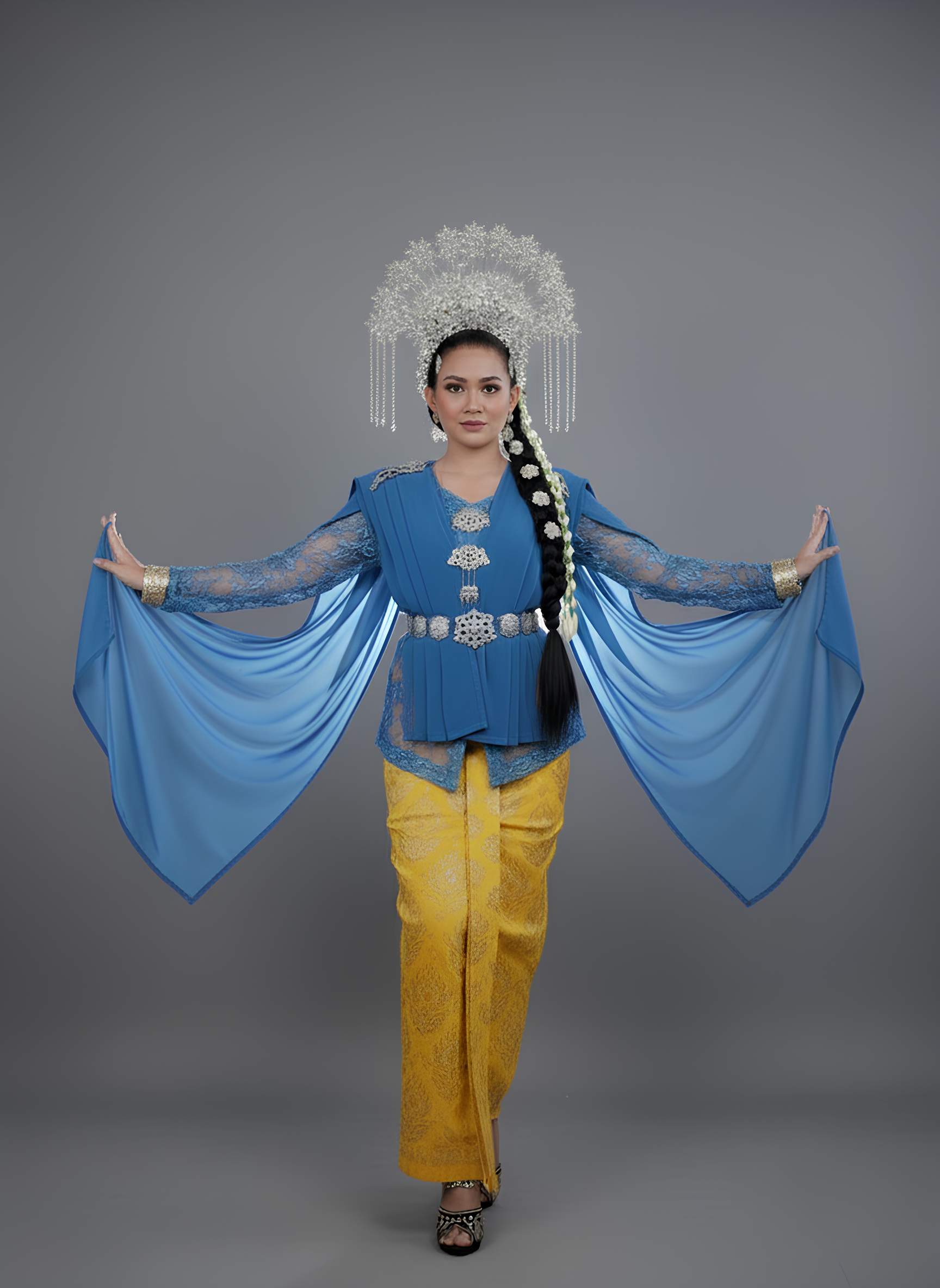
Picture
1
Video
No record
Today's Visitor
175
Number of Visitors
1886
Introduction and history
- The Gangga Sari attire, presently known as the Zarith Gangga, represents one of Perak’s most treasured forms of traditional dress. Its origins trace back to the era of the Gangga Negara Kingdom, an early Malay polity that flourished between the 6th and 11th centuries in the regions of Dinding and Beruas, Perak. During this period, the attire of the Gangga Negara society was greatly influenced by Hindu–Buddhist aesthetics, characterised by the use of kemban (a wrapped upper garment) and long flowing shawls draped gracefully down the back.
- Over time, as Islam took root and the Perak Sultanate emerged as the successor to Gangga Negara’s royal lineage, the region’s attire evolved in both form and function. The transition from the semi-bare style to a more modest and refined design reflected the growing influence of Islamic values and Malay courtly etiquette. This transformation inspired the reinterpretation of the Gangga Sari costume, retaining its classical elegance while aligning it with the ideals of modesty and grace embodied by Malay-Muslim women.
- A key figure in this revival was Tuan Haji Bashi, a heritage advocate and traditional costume designer from Perak. He refined the original concept into a short kebaya-style outer garment that covered the chest and hips, drawing inspiration from the Kota Bharu kebaya. The outfit was completed with an elongated shawl pinned neatly at the shoulder and allowed to cascade elegantly down the back, enhancing the silhouette with fluid movement and sophistication.
- The term “Zarith Gangga” was later adopted after Princess Zarith Sofea, daughter of the Sultan of Perak, donned the attire during her royal wedding. This event marked a revival of Perak’s traditional costume within a contemporary royal context. In tribute to the princess, the attire was renamed in her honour. Since then, the Gangga Sari has come to symbolise not only royal elegance but also the cultural identity and refined artistry of Perak’s Malay heritage. It stands as a testament to the harmonious blending of history, tradition, and Islamic refinement within one timeless expression of Perak’s sartorial legacy.
- Traditionally, the Gangga Sari, also known as the Zarith Gangga, was an attire reserved exclusively for the nobility and royal families of Perak. Its use signified social rank and prestige within the royal court, serving as both a ceremonial and bridal costume that embodied the dignity, grace, and refined character of Perak’s Malay women.
- Following its appearance worn by Princess Zarith Sofea during her royal wedding, the attire gained widespread admiration among women across Perak. Its elegant form and regal symbolism made it an iconic and influential costume, no longer confined to the palace but embraced by the broader community. From that moment, the Gangga Sari became a popular bridal attire, cherished for its blend of heritage, modesty, and timeless beauty.
- Today, the Gangga Sari has transcended its aristocratic origins to become a living cultural heritage of Perak. It is frequently worn by the public during traditional weddings, cultural performances, and heritage exhibitions, symbolising the continuity of Perak’s identity through dress. Evolving from a royal emblem into a shared symbol of pride and tradition, the Gangga Sari stands as a graceful testament to how Malay cultural heritage continues to flourish within modern society.
The Gangga Sari attire is incomplete without its array of traditional accessories, each carefully chosen to enhance the grace and stature of the wearer. These adornments are not merely decorative but also carry cultural symbolism that reflects refinement, femininity, and Malay identity.
Hair Ornaments (Cucuk Sanggul / Sanggul Lintang / Cucuk Sudu)
These ornamental pins are used to style and beautify the hair, often forming part of elaborate traditional buns. For women who wear the hijab, ready-made or decorative hair buns are adapted beneath the scarf to preserve the elegance and silhouette of the traditional look while maintaining modesty.
Jasmine Flowers
Jasmine flowers are inserted among the hair ornaments or pinned around the bun as a fragrant embellishment. For women with shorter hair or simpler hairstyles such as sanggul belah dua, sanggul lipat pandan, sanggul tekuk, or sanggul siput, the jasmine strands are tucked behind the bun and left to fall gently over the right shoulder.
Earrings
For women who do not wear the hijab, gold or silver earrings featuring traditional floral or drop motifs are often paired with the dokoh and hair ornaments to complete the regal look. For those who wear the hijab, earrings are styled in a contemporary fashion, either as small, subtle studs worn beneath the scarf or as clip-on ornaments attached externally to the hijab for a modern yet culturally rooted appearance.
Brooch Set (Dokoh / Kerongsang Derai Tiga)
The dokoh or triple-tiered brooch is worn at the chest in a cascading arrangement. It typically consists of three linked pieces connected by fine chains, crafted from gold or silver and intricately engraved with floral motifs such as bunga tanjong or round shapes.
Waist Buckle (Pending)
Traditionally made of brass overlaid with silver or gold, the pending functions as both a decorative clasp and a fastening piece for the waist sash. It is positioned prominently at the front, covering the point where the kebaya and shawl overlap. In some versions, the pending takes the form of an engraved belt worn independently of the sash, offering flexibility and comfort without compromising its ornamental purpose.
Bracelets and Anklets
The bracelets are typically crafted from silver or gold in a bangle design adorned with fine engravings inspired by Javanese chisel motifs. They are traditionally worn in pairs, one on each wrist to create balance and symmetry. Similarly, the anklets, also made of precious metal, are worn as a matching pair on both ankles, serving as a graceful finishing touch that complements the overall ensemble.
Rings
Rings are worn on one or several fingers as a mark of completeness in traditional Malay adornment. Commonly made from gold, silver, or gemstone settings, they add colour and elegance to the hands, depending on the people who wear the ensemble.
Embroidered Slip-on Shoes (Kasut Sarung Tekat Benang Emas)
The ensemble is perfected with a pair of embroidered velvet slip-on shoes, known locally as kasut sarung tekat benang emas. A distinctive feature of Perak’s craftsmanship, the shoes are covered in gold-thread embroidery (tekat), forming floral and swirling cloud motifs.
The materials used in the making of the Gangga Sari ensemble reflect the exclusivity and royal elegance of Perak’s courtly heritage.
Blouse Material (Outer and Inner Garment)
The blouse is made from handwoven songket, pure silk, or soft velvet fabric. It features a short kebaya-style cut, with the back extending slightly over the hips and the front folded in pleats reminiscent of the Kota Bharu kebaya design.
Shawl Material (Selendang)
The shawl is crafted from long silk or soft organza fabric, draped gracefully from the shoulders down to knee length at the back. Its colour is usually coordinated with the blouse.
Waist Sash (Bengkung) and ornamental clasp (Pending) Material
The bengkung (waist sash) is made from velvet or stiff fabric embroidered with gold threads, while the pending (ornamental clasp) is fashioned from engraved gold or brass.
Skirt Material (Kain)
The lower garment is arranged in overlapping pleats (wiron style), typically using Perak handwoven songket adorned with traditional floral or tampuk manggis (mangosteen calyx) motifs.
Wearing the Gangga Sari ensemble requires precision and careful arrangement, as each layer of the attire carries its own purpose and symbolism, reflecting the modesty and grace of Perak’s Malay women. The process begins with the inner blouse and lower garment, where the skirt is folded into neat overlapping pleats (wiron style) at the front, forming a balanced and refined structure down the centre.
Next, the outer garment or short kebaya is worn over the inner blouse. The back of the kebaya is designed to cover the hips, while the front is slightly shorter to reveal the pleated skirt beneath. This is followed by the waist sash and ornamental clasp, which are fastened securely around the waist. Together, they serve both as a functional binder and as a decorative feature that accentuates the wearer’s silhouette in a refined, dignified manner.
A long shawl is then pinned at the front of the waist sash, draped gracefully over the shoulder, and allowed to fall down the back to about knee length. Traditional accessories such as hair ornaments, jasmine flowers and gold earrings are used to enhance the hairstyle and facial presentation. The triple-layered brooch is pinned at the chest in descending tiers, while bracelets, anklets, and rings are worn to complete the ensemble’s traditional adornment.
Finally, the outfit is perfected with a pair of embroidered slip-on shoes (kasut sarung tekat benang emas). These shoes serve not only as footwear but also as a symbol of Perak’s intricate embroidery craftsmanship, reinforcing the royal and artistic essence of the attire. When worn with composure and attention to detail, the Gangga Sari ensemble radiates the refined aesthetics, modest elegance, and enduring pride of Perak’s Malay cultural heritage.
-
Reference Source
Bahan Bacaan
Chan, H. (2010, Oktober). Baju tradisional negeri Perak. Retrieved from https://himikochan.blogspot.com/2010/10/baju-tradisional-negeri-perak.html
Jabatan Kebudayaan dan Kesenian Negara (JKKN). (2016). Kenali busana tradisional negeri Perak. Buletin Citra Karya JKKN, Bil. 1, 13. Retrieved from https://issuu.com/jkkngov/docs/citra_karya_jkkn_2016_bil1_1_final/13
Perak Tourism. (2023, Jun 10). Busana tradisional negeri Perak – Busana Gangga Sari dan Zarith Gangga. [Tweet]. X (Twitter). Retrieved from https://x.com/PerakTourism/status/1667381070130446342
Hardy Shafii, A. S., & Nazaruddin Zainun. (2017). Masyarakat Nusantara dalam budaya: Warisan dan sejarah. Pulau Pinang: Penerbit Universiti Sains Malaysia.
Location
State JKKN Contact Information
Encik Yufazli Yusof
Cultural Officer
Jabatan Kebudayaan dan Kesenian Negara Perak
Kompleks JKKN Perak,
Lot 20561@20565 Jalan Caldwell,
Off Jalan Raja Di Hilir,
30350 Ipoh,
PERAK DARUL RIDZUAN
05-253 7001 / 05-254 1027
Use the form below to contact the Informant/Figure/Editor/Researcher directly. We will respond to your inquiry as soon as possible!


