

ARTS AND CULTURE INFORMATION GATEWAY
Immerse yourself in the colorful world of art and culture! From traditional heritage to contemporary works, discover uniqueness that reflects the nation's identity and identity
TARIAN INANG TUA

Picture
1
Video
Available
Today's Visitor
3
Number of Visitors
3815
Introduction and history
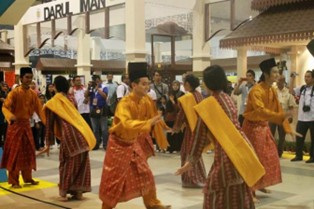
The Mak Inang Tua dance was a popular phenomenon in Perlis and Kedah during the 1940s and 1950s. This dance is believed to have originated from Malay palaces, performed to entertain royal family members and distinguished guests. Mak Inang, a palace maid associated with this dance, is believed to have created its movements. The term Inang, meaning "nanny," refers to the caretakers of royal children in palaces during that time. The dance is performed in pairs, with female dancers using a scarf as the primary prop.

Performed at public events organized by government and private sectors for the enjoyment of the general public and tourists.
• Female dancers: Long kebaya blouse with a brooch (kerongsang) at the chest. Hair is adorned with pins (cucuk sanggul) and decorative flowers. A scarf is worn over the shoulders to enhance the elegance of the movements.
• Male dancers: Songkok (traditional Malay cap) paired with a samping (waist cloth) worn either outside or tucked inside. Female dancers wear shoes, while male dancers wear traditional sandals (capal).
• Female dancers use a scarf as a prop throughout the performance.
• Instruments include:
o Frame drum (rebana).
o Violin.
o Drum.
• The number of pairs usually ranges from 4 to 6, but the number can be adjusted based on the size of the stage. Larger stages allow for more dancers to perform.
• Dance movements focus heavily on the hands, which are raised to shoulder level by both male and female dancers.
• The dance begins with hand variations performed in front of the body, turning left and right, then raising the hands and extending them forward. This sequence is repeated and typically starts with male dancers performing silat-inspired steps before transitioning into the main movements.
• Male dancers then place the female dancer’s scarf on their shoulders, continuing to dance while standing. A unique feature of this dance is the male dancer's playful teasing, extending his hand toward the female dancer, who playfully fends it off.
• This sequence is repeated multiple times by each pair. Another variation involves male dancers sitting and performing frog-like jumps, followed by female dancers doing the same. The dancers then stand and return to the initial variation, repeating it until the dance concludes.
• Mak Inang Tua was recreated in 1994 by Razali bin Ismail, better known as "Tok Ram." He reimagined the dance based on community life, interactions, playful courtship, and teasing.
• Previously performed in palaces, the dance has become a widely loved folk dance throughout Kedah and Perlis.
Reference Source
https://pkbu.unimap.edu.my/
https://pemetaanbudaya.jkkn.gov.my/senibudaya/detail/692/pengenalan
https://ecentral.my/tarian-inang/
https://www.scribd.com/document/382604818/Asal-Usul-Tarian-Inang-docx

Location
State JKKN Contact Information
Siti Rohayu binti Muhamad
Cultural Officer
Jabatan Kebudayaan dan Kesenian Negara, Perlis
Kompleks JKKN Perlis
Persiaran Wawasan Kangar
01000 Kangar
PERLIS
019-504 0015
Use the form below to contact the Informant/Figure/Editor/Researcher directly. We will respond to your inquiry as soon as possible!


