

ARTS AND CULTURE INFORMATION GATEWAY
Immerse yourself in the colorful world of art and culture! From traditional heritage to contemporary works, discover uniqueness that reflects the nation's identity and identity
ADAT RESAM DAN BUDAYA KAUM BRUNEI - ADAT PERKAHWINAN (ISTIADAT BADAK-BADAK MANDI DAN MALAM BERINAI)




Picture
4
Video
No record
Today's Visitor
26
Number of Visitors
3830
Introduction and history
The wedding traditions of the Brunei community in Sabah reflect the unique beauty and richness of their cultural heritage through a variety of symbolic rituals. Three significant traditional ceremonies form the structure of the Brunei wedding customs in Sabah: the powder bath (Badak-Badak Mandi) Ceremony, the powder night (Malam Bebadak), and Henna Night. These customs are integral to the wedding process, particularly for both the bride and groom, to ensure purity, blessings, and respect for the sanctity of marriage.
Originally, these ceremonies were performed after the engagement, typically within one to three months before the wedding. However, some families observe these rituals seven days before the marriage solemnization (akad nikah) as part of traditional preparations. In modern times, due to time constraints faced by couples—especially those who are working or have limited leave—these rituals are often conducted a day before the wedding. Nowadays, the ceremonies are usually combined with the Henna Night to streamline the process and accommodate the couple's schedule.
The primary purpose of the powder bath ceremony is to enhance the radiance of the bride and groom as they prepare to take their place on the wedding dais. According to the beliefs of the Brunei community in Sabah, the ingredients used in this ritual are thought to smooth the skin and brighten the face in preparation for the wedding day.
Traditionally, this ceremony is carried out for up to seven consecutive days to ensure that the bride and groom remain indoors and continuously apply a special body scrub made from a mixture of rice flour and natural ingredients like turmeric. This mixture not only holds symbolic significance for enhancing the bride and groom's appearance but has also been scientifically proven to help the skin appear smoother, brighter, and more radiant.
-
-
Here is the procedure for the customs, starting from the Badak-Badak Mandi ceremony to the Babadak night and the Henna night:
Badak-Badak Mandi Ceremony
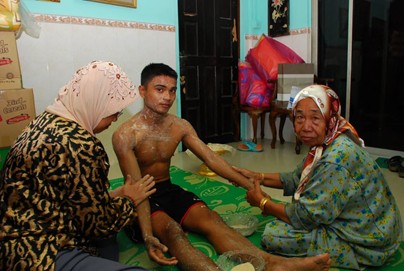
Physically, the Badak-Badak Mandi ceremony aims to enhance the radiance and beauty of the bride and groom. Symbolically, it serves as an official declaration that both individuals have entered the "Pengangunan" phase, during which they are fully cared for by a Penganggun or Mak Andam (traditional wedding caretaker). The Penganggun is usually an experienced and skilled elder, often an older woman, trusted for her expertise in conducting the traditional Badak-Badak Mandi rituals. Her role is to meticulously prepare the couple according to traditional customs, ensuring that every step of the process is carried out with precision and respect for cultural heritage.
According to tradition, brides entering the Pengangunan phase are required to wear all-white attire and are not allowed to leave their rooms freely for a period of seven (7) days leading up to the wedding or reception. Strictly adhering to these customs, some brides do not leave their homes at all and remain confined to their rooms. While grooms face fewer restrictions compared to brides, it is recommended that they also follow the customs to ensure their appearance and aura on their wedding day are strikingly captivating. Additionally, brides are forbidden from looking into mirrors during this phase, as it is believed to disrupt the charm-enhancing rituals, a phenomenon known as “Libas.”
The ceremony is conducted separately at the respective homes of the bride and groom and is exclusively attended by close family members. The event begins with the bride or groom being escorted from their room to the center of the ceremony area by the Penganggun. Brides typically wear handwoven attire, such as Baju Kurung or a long Kebaya, paired with jewelry like bracelets, earrings, a headpiece (Gandi), a waist cloth (kain kapit), and a shawl. Grooms, on the other hand, wear traditional baju Melayu, complemented with a Samping (waist cloth) and a Songkok.
The ceremony begins with the application of traditional powder made from a mixture of rice flour, jasmine flowers, and turmeric. The bride's or groom's parents are the first to apply the powder, followed by close family members. The powder is applied only to the forehead and the palms as a symbolic gesture marking the commencement of the Badak-Badak Mandi ritual. Once all family members have participated, the Penganggun and their assistant take over, applying the traditional powder across the bride's or groom's entire body, from the face to the feet. This act signifies purification and preparation for the wedding day.


-
Reference Source
Asmiaty Amat & Saidatul Nornis Hj. Mahali. (2012). Brunei. Dalam Siri Etnik Sabah ITBM-UMS: Murut & Pelbagai Etnik Kecil Lain di Sabah. Institut Terjemahan Buku Malaysia.
Haji, & Nur Raihan Mohamad. (2021). Symbolism in Brunei Malay Wedding Customs. Springer EBooks, 239–253. https://doi.org/10.1007/978-981-33-4721-2_14
Yassin, M., & Humin Jusilin. (2020). Cultural Objects Ethnic Wedding Traditions Brunei Malay in the Federal Territory of Labuan. https://doi.org/10.2991/assehr.k.200323.062
Location
State JKKN Contact Information
Puan Nurshahrinna Syahrial
Cultural Officer
Jabatan Kebudayaan dan Kesenian Negara, Sabah
Kompleks JKKN Sabah,
Jalan Tasik off KM4 Jalan Penampang,
88200 Kota Kinabalu
SABAH
088-205070


