

ARTS AND CULTURE INFORMATION GATEWAY
Immerse yourself in the colorful world of art and culture! From traditional heritage to contemporary works, discover uniqueness that reflects the nation's identity and identity
 Persatuan Kebudayaan Tatana Sabah, Peti Surat 71, Kg. Bundu Batu 4, 89747 Kuala Penyu, Sabah.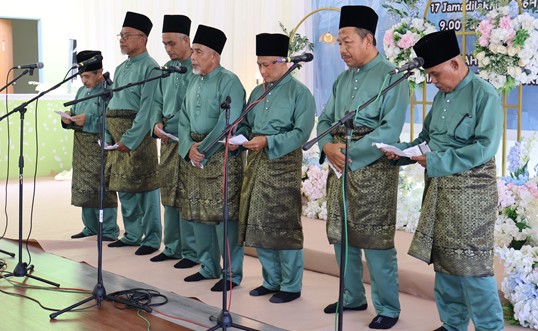

Picture
3
Video
Available
Today's Visitor
4854
Number of Visitors
11154
Introduction and history
Marhaban is a form of Islamic art performance popular in Perak. The word ( بحرم) "Marhaba" is derived from the Arabic verb ( بحر) "Rahaba", which means spacious or vast. It conveys the meaning of a greeting or expression of respect used to welcome someone during a meeting. Some also translate this term as "welcome."
Marhaban holds significant functions and roles as it is an Islamic tradition frequently practiced in various religious events, such as welcoming a newborn, weddings, Quran completion ceremonies, and the celebration of the Maulid Nabi Muhammad SAW (the Prophet’s birthday). This tradition serves as a way to draw closer to Allah SWT through the recitation of praises, salutations (salawat), and prayers.
In addition, Marhaban acts as a form of Islamic expression that reinforces religious values within the community. It serves as an effective medium for dakwah (Islamic preaching), often accompanied by delivering educational and spiritual messages that inspire and provide moral guidance to the audience. In this way, Marhaban is a form of worship and a medium for spiritual education, inspiring individuals to strive for self-improvement.
Moreover, Marhaban reflects cultural acculturation grounded in Islamic values, aligning it with shariah principles. From a spiritual perspective, Marhaban invites Muslims to feel a closer connection to Allah SWT and the Prophet Muhammad (PBUH) through heartfelt prayers and praises. Specifically, during the Maulid Nabi celebration, Marhaban plays a pivotal role in expressing love for the Prophet by recounting his virtues, struggles, and noble characteristics.
Additionally, Marhaban is a form of religiously infused entertainment that adheres to Islamic values and is free from elements contrary to Shariah. Overall, Marhaban seamlessly integrates spiritual and cultural elements while functioning as a medium for Dakwah, education, and strengthening Islamic identity within the community.
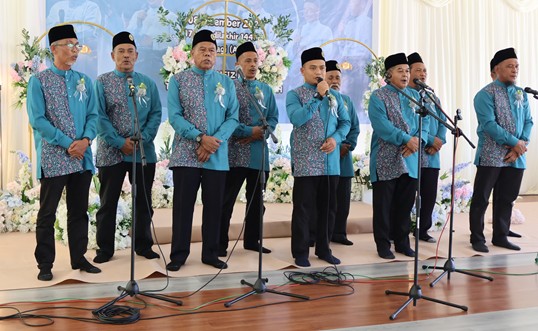
This performance does not have specific attire or costumes traditionally associated with it. However, groups performing Marhaban often choose to wear coordinated outfits that correspond to the formality of the event. Wearing elegant attire serves as a symbolic gesture to celebrate the birth of the Prophet Muhammad (PBUH).
For women in Marhaban groups, they typically wear Baju Kurung or long jubah that fully adhere to modest dressing guidelines. For men they usually wear a complete Baju Melayu set paired with a songkok, showcasing the exclusive identity of Malay culture.
Traditionally, the art of Marhaban does not involve any musical accompaniment. Instead, the harmonious choral singing of the group forms the melodious rhythm of Marhaban. Among the melodies commonly used in Marhaban are Syira, Rakbi, Nahwan, Ras, Babri, Masri, Hajaka, and Haiya. The most popular song in the state of Perak, however, is Marhaban Ya Rabbi’.
Marhaban is performed in groups by either women or men. Each group presents it in a linear formation (two or three rows) similar to nasyid, delivering the performance with enthusiasm as a sign of respect for the Prophet Muhammad (PBUH).
At the beginning of the performance, the group leader initiates with the recitation of Salawat or directly starts singing the Marhaban lyrics. The leader sings the stanza first as a solo, followed by the group members singing together in unison. In certain stanzas, the group members respond to the leader's solo singing with the harmonious exclamation of "Allah." The main stanza sung collectively by the group is in Arabic, for example:
Marhaban Ya Rabbi',
Marhaban Syahrul Anwar,
Marhaban Ya Syafi',
Bilrahmah Wal Anwar.
The singing pauses depending on the length of the lyrics and the type of Marhaban being performed. To conclude the performance, the group leader recites the phrase:
As-Solatu 'Alan Nabi, Was-Salamu 'Alar Rasul.
An-Nabiyyul Ummi, Bir-Ridha Wal Qabul.
-
Reference Source
Bahan Bacaan
Abd Rahman, R., Alias, H., Zakaria, M. H., & Razali, N. W. N. (2024). Development and Usability of the Arabic Language Module “Marhaban” Based on CEFR (A1 & A2 Levels). SIBAWAYH Arabic Language and Education, 5(2), 55-69.
Samat, A. B., Tibek, S. R., & Muhamat, R. (2014). Tahap Pengetahuan dan Minat Remaja Terhadap Seni Barzanji dan Marhaban: Kajian di Kalangan Pelajar SMKA Negeri Johor. Sains Humanika, 66(1).
Samat@Darawi, A. B., Tibek, S. R., Muhamat@Kawangit, R., & Hamzah, A. R. (2015). [History and Contribution of Barzanji and Marhaban Practices in The Main Councils of Society] Sejarah serta Sumbangan Amalan Barzanji dan Marhaban dalam Majlis-Majlis Utama Masyarakat. Jurnal Islam Dan Masyarakat Kontemporari, 9, 121-132.
Samat@Darawi, A. B., Tibek, S. R., Muhamata@Kawangit, R., & Hamzah, A. R. (2015). Sejarah Serta Sumbangan Amalan Barzanji Dan Marhaban Dalam Majlis-Majlis Utama Masyarakat. Jurnal Islam Dan Masyarakat Kontemporari, 9, 157.
Location
State JKKN Contact Information
Encik Yufazli Yusof
Cultural Officer
Jabatan Kebudayaan dan Kesenian Negara Perak
Kompleks JKKN Perak,
Lot 20561@20565 Jalan Caldwell,
Off Jalan Raja Di Hilir,
30350 Ipoh,
PERAK DARUL RIDZUAN
05-253 7001 / 05-254 1027
Use the form below to contact the Informant/Figure/Editor/Researcher directly. We will respond to your inquiry as soon as possible!


